


 Nuskha Maa
−
×
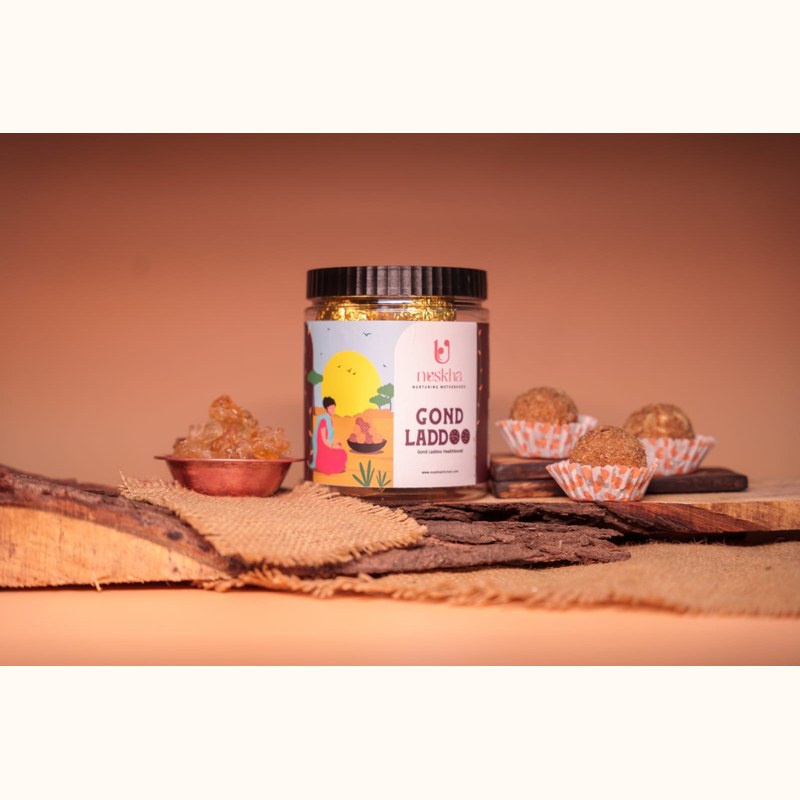
A good gond laddoo comes down to five things: real edible gum fried properly in ghee, pure cow ghee and not oil or vanaspati, whole wheat flour roasted slowly, a natural sweetener like jaggery instead of white sugar, and a generous share of dry fruits. Everything else, from the spices to the shelf life, tells you how carefully it was made.
Most boxes on the shelf look the same, so the only way to tell them apart is to know what should be inside and check the label. Here is what we look for, ingredient by ingredient.
Gond is edible gum, also called dink. In a good laddoo it is fried in hot ghee until each piece swells up, turns white and crunchy, then crushed. If the gond is under-fried, you bite into hard, glassy bits that stick to your teeth. That is the quickest sign of a rushed batch.
Ghee is the backbone of a gond laddoo: the gond is fried in it and the flour is roasted in it. Cheaper laddoos use refined oil, vanaspati or a blend, which you can often smell and taste as a flat, greasy finish. Look for cow ghee named clearly on the label, and ideally A2 bilona ghee.
What "A2" actually means. Cow's milk contains a protein called beta-casein, which comes in two main types, A1 and A2. Indigenous Indian breeds such as Gir, Sahiwal, Tharparkar and Rathi naturally give milk with only the A2 type. Most high-yield foreign breeds on commercial dairy farms, such as Holstein Friesian and Jersey and their crosses, give milk with A1 or a mix of both. So A2 ghee simply means ghee made from the milk of desi breed cows, not videshi breeds. Most "cow ghee" sold in India comes from mixed or crossbred herds, so the A2 label is worth looking for.
What "bilona" means. It is the old way of making ghee at home: the milk is set into curd, the curd is churned to separate the makkhan, and the makkhan is slowly heated into ghee. It takes far more milk to make a kilo of ghee this way than by separating cream in a factory, which is why real A2 bilona ghee costs more, and why it is the first thing a cheap laddoo cuts.
The flour should be whole wheat (atta), roasted in ghee on a low flame until it turns golden and smells nutty. Raw-tasting or pale laddoos mean the roasting was cut short. Maida or a large share of semolina is a shortcut to watch for. The grain matters too: Sharbati wheat from Madhya Pradesh is prized for its golden grain and naturally sweet taste, and the best atta is milled from it.
Traditional gond laddoos are sweetened with jaggery or dhaga mishri. White sugar or bura makes the laddoo cheaper and sweeter, and hides the taste of the ghee and gond. Organic jaggery, made without chemical clarifiers, is the cleanest choice. If you want less sugar, look for a stevia option instead of a sugar-free claim with no sweetener named.
Almonds, cashews and coconut should be easy to see when you break a laddoo, not just a few flecks on top. Dry fruits are the most expensive part of the recipe, so they are the first thing that gets cut. Check where they appear in the ingredient list: ingredients are listed in order of quantity.
Home recipes add a little black pepper, dry ginger or similar warming spice. It is a small detail, but it shows the maker is following a family recipe and not a factory formula.
A gond laddoo made with ghee and no preservatives keeps for weeks, not a year. A shelf life of around two to three months is what you should expect. Anything much longer usually means added preservatives or very low moisture from over-processing.
We make our Gond Laddu by hand in our Jaipur kitchen, and only after your order comes in. Here is how it stacks up against the checklist:
| What to check | Our gond laddoo |
|---|---|
| Gond | Babool gond, fried in ghee until it puffs |
| Ghee | A2 bilona ghee from desi breed cows, nothing else |
| Flour | Sharbati whole wheat, slow-roasted in the same ghee |
| Sweetener | Your choice: organic jaggery, dhaga mishri or stevia |
| Dry fruits | Top-grade almonds, cashews and coconut |
| Warming spice | A pinch of black pepper |
| Preservatives | None. Keeps 80 days in a cool, dry place |
| Label | FSSAI licence 12223027000203, nutrition shown per laddoo |
A 500 g box has about 15 laddoos and a 1 kg box about 30. If you are buying for a new mother, our Gond Ke Laddu follows the same recipe in a 1 kg box, with ashwagandha as an option.
Check that cow ghee is named on the label, and taste it: ghee leaves a rich, clean finish, while oil or vanaspati feels greasy and flat.
The gond was not fried long enough to puff up. Properly fried gond is light and crunchy.
Jaggery is the traditional sweetener and adds its own flavour. White sugar is cheaper and tends to hide the taste of the ghee and gond.
Without preservatives, about two to three months in a cool, dry place. Ours keeps for 80 days.
It depends on the size. Ours are about 33 g each, so roughly 30 in a 1 kg box.